*Finance Minister Satsuki Katayama indicated that gradual interest rate increases are expected alongside active fiscal policy, reinforcing confidence in the BoJ’s monetary normalization path.
*Gradual rate hikes could help narrow the U.S.-Japan yield gap, reduce carry trade demand, and improve investor confidence, although the immediate impact on the Yen remains limited.
*Despite a more constructive policy backdrop, USD strength, elevated oil prices, and fiscal concerns continue to pressure the Yen.
Market Summary:
Japan’s Finance Minister Satsuki Katayama recently stated that gradual interest rate increases are expected as the government continues its active fiscal policy. This remark underscores a delicate policy balancing act: supporting economic growth through fiscal stimulus while allowing the Bank of Japan (BOJ) to pursue monetary normalization to address inflation and currency weakness.
The statement signals government acceptance of the BOJ’s gradual tightening path, which aligns with recent rate hikes to around 1% and efforts to manage rising JGB yields. By acknowledging rate rises, it aims to reassure markets about fiscal sustainability and reduce perceptions that the government might pressure the BOJ to keep policy overly loose. This comes amid large spending plans that have fueled concerns over debt issuance, inflation risks, and potential crowding out in bond markets. Katayama’s comments reflect an effort to maintain market confidence while pursuing “proactive and responsible” fiscal measures under the current administration.
For the Yen, this development is broadly supportive in the medium term but offers limited immediate relief. Gradual BOJ rate hikes narrow the interest rate differential with the U.S., potentially attracting capital inflows and reducing the attractiveness of Yen-funded carry trades. A stronger policy framework that pairs fiscal expansion with monetary tightening could also mitigate excessive Yen weakness by anchoring inflation expectations and supporting investor confidence.
However, the emphasis on “gradual” rises and continued active fiscal policy highlights ongoing tensions. Persistent government borrowing and spending may keep upward pressure on JGB yields and sustain inflation risks, which could limit the pace of BOJ tightening. The Yen remains vulnerable to external factors such as U.S. dollar strength, oil prices, and global risk sentiment. As of July 10, 2026, USD/JPY trades around 161.70, reflecting prolonged Yen weakness near multi-decade highs.
In the near term, the Yen is likely to remain under pressure with a bias toward modest stabilization or mild appreciation if BOJ communications reinforce the tightening bias. Support may emerge around current levels if intervention threats materialize or if U.S. data softens dollar momentum. However, risks of further weakness toward 163–165 persist if fiscal concerns dominate or oil-driven inflation keeps global yields elevated.
Technical Analysis
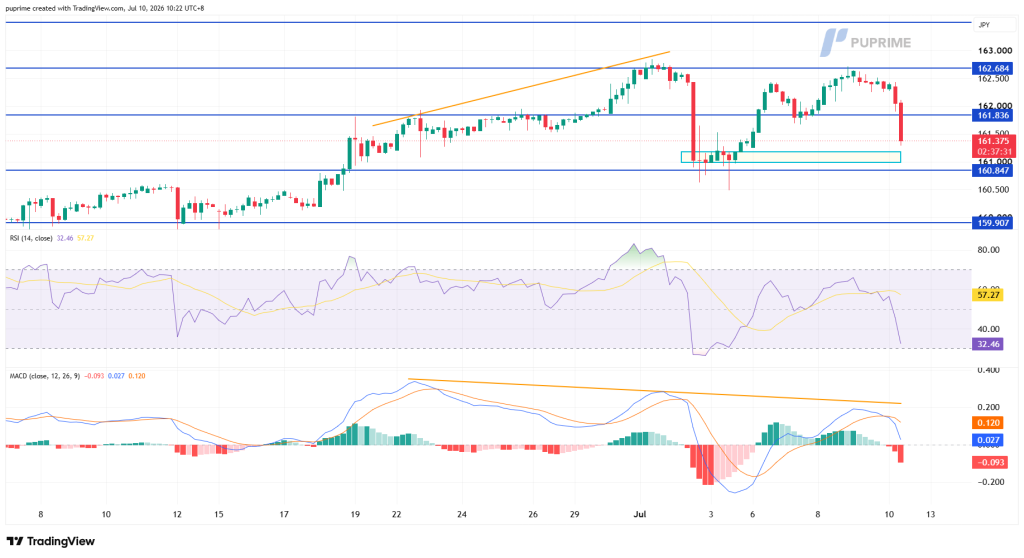
USDJPY, H4
USD/JPY has come under renewed selling pressure after retreating sharply from its record high, with the pair now approaching its first major support zone near the 161.00 level. The decline suggests that bullish momentum has weakened, increasing the likelihood of a deeper technical correction in the near term.
The 161.00 level represents an important support area and will be closely watched by market participants. A successful defense of this zone could encourage bargain buying and trigger a short-term rebound. However, if bearish momentum continues to strengthen, USD/JPY may break below this critical support, reinforcing the negative near-term outlook.
A decisive move below 161.00 would expose the next key psychological support level at 160.00. A break toward this area would signal that sellers have firmly regained control of the market and could accelerate the ongoing corrective move from the pair’s all-time high.
Momentum indicators also support the weakening technical outlook. The Moving Average Convergence Divergence (MACD) has formed a lower-high pattern, indicating a bearish divergence and suggesting that upside momentum is fading despite the pair’s recent strength. This development is often viewed as an early warning signal of a potential trend reversal and reinforces the case for further downside.
Resistance Levels:161.85, 162.70
Support Levels:160.85, 159.90
Start trading with an edge today
Trade forex, indices, metal, and more at industry-low spreads and lightning-fast execution.
Start trading with deposits as low as $50 on our standard accounts.
Get access to 24/7 support.
Access hundreds of instruments, free educational tools, and some of the best promotions around.
Our products and services are not offered or made available to residents of your jurisdiction. The information on this Website is not directed at persons in your jurisdiction and is not intended as an offer, solicitation, or promotion of our products or services to them.
By clicking “I Understand”, you acknowledge this notice and confirm that you are accessing this Website at your own initiative. Access to this Website does not mean that our products or services are available to you.
Please be advised that our products and services are currently unavailable to residents and entities located in the Philippines.
This restriction is a result of our firm commitment to adhering to applicable legal and regulatory requirements in all jurisdictions where we operate. In line with our internal compliance protocols and evolving global standards, we continuously assess and update access to our platform to ensure full regulatory alignment.
We appreciate your understanding and cooperation.
If you believe this restriction has been applied in error, please contact our support team for further assistance.
Dear Valued Client,
As part of PU Prime’s ongoing commitment to providing a stable and reliable trading environment, please be informed of the following weekly weekend scheduled optimisation activities:
We sincerely apologise for any inconvenience this may cause as we strive to provide you with better service. PU Prime is committed to providing you with the best trading experience and this Weekly Scheduled Optimisation Notice will enable us to ensure that you trade without any unexpected interruptions.
For other upgrades that may involve longer disruptions to your trading, we will announce them ahead of time in a separate announcement.
Important Notice: Please note the Website is intended for individuals residing in jurisdictions where accessing the Website is permitted by law.
Please note that PU Prime and its affiliated entities are neither established nor operating in your home jurisdiction.
By clicking the "Acknowledge" button, you confirm that you are entering this website solely on your own initiative and not as a result of any specific marketing outreach. You wish to obtain information from this website which is provided on a reverse solicitation basis in accordance with the laws of your home jurisdiction.
Please note the Website is intended for individuals residing in jurisdictions where accessing the Website is permitted by law.
Please note that PU Prime and its affiliated entities are neither established nor operating in your home jurisdiction.
By clicking the "Acknowledge" button, you confirm that you are entering this website solely based on your initiative and not as a result of any specific marketing outreach. You wish to obtain information from this website which is provided on reverse solicitation in accordance with the laws of your home jurisdiction.
Ten en cuenta que el sitio web está destinado a personas que residen en jurisdicciones donde el acceso al sitio web está permitido por la ley.
Ten en cuenta que PU Prime y sus entidades afiliadas no están establecidas ni operan en tu jurisdicción de origen.
Al hacer clic en el botón "Aceptar", confirmas que estás ingresando a este sitio web por tu propia iniciativa y no como resultado de ningún esfuerzo de marketing específico. Deseas obtener información de este sitio web que se proporciona mediante solicitud inversa de acuerdo con las leyes de tu jurisdicción de origen.