*Falling oil prices reduced inflation concerns and pressured U.S. Treasury yields lower
*The U.S. dollar weakened as safe-haven demand eased amid improving geopolitical sentiment
Market Summary
The U.S. dollar and gold markets continue to trade under the influence of rapidly shifting geopolitical developments surrounding potential US–Iran diplomacy, while investors simultaneously monitor Federal Reserve expectations, Treasury yields, and global inflation risks. Market sentiment improved significantly after President Donald Trump stated that a peace agreement with Iran was “largely negotiated” and could be finalized soon, potentially extending the current ceasefire, reopening the Strait of Hormuz, and stabilizing global energy supply flows. The prospect of easing tensions in the Middle East triggered a broad risk-on reaction across financial markets, reducing immediate safe-haven demand for both the U.S. dollar and gold while supporting equities, cryptocurrencies, and higher-risk currencies.
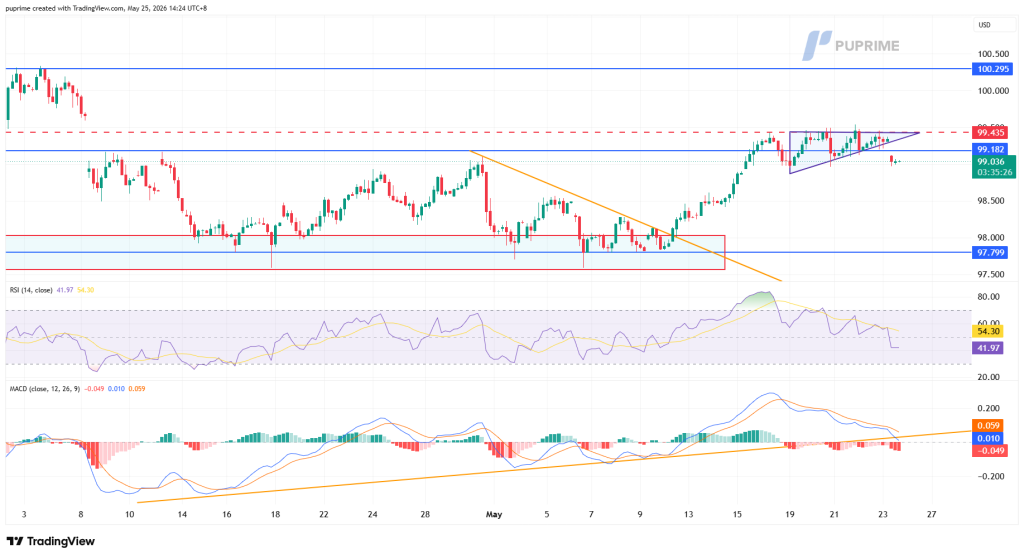
One of the biggest immediate market reactions came from crude oil, where prices declined sharply as traders aggressively unwound geopolitical risk premiums that had supported energy markets in recent weeks. Falling oil prices helped ease inflation concerns globally, which subsequently pressured U.S. Treasury yields lower and weakened the U.S. Dollar Index (DXY). Markets increasingly believe that softer energy prices could reduce pressure on the Federal Reserve to maintain an aggressively hawkish stance moving forward. As a result, the dollar lost part of its recent safe-haven strength, with DXY fluctuating around the 99.00–99.40 region despite lingering geopolitical uncertainty still providing some underlying support.
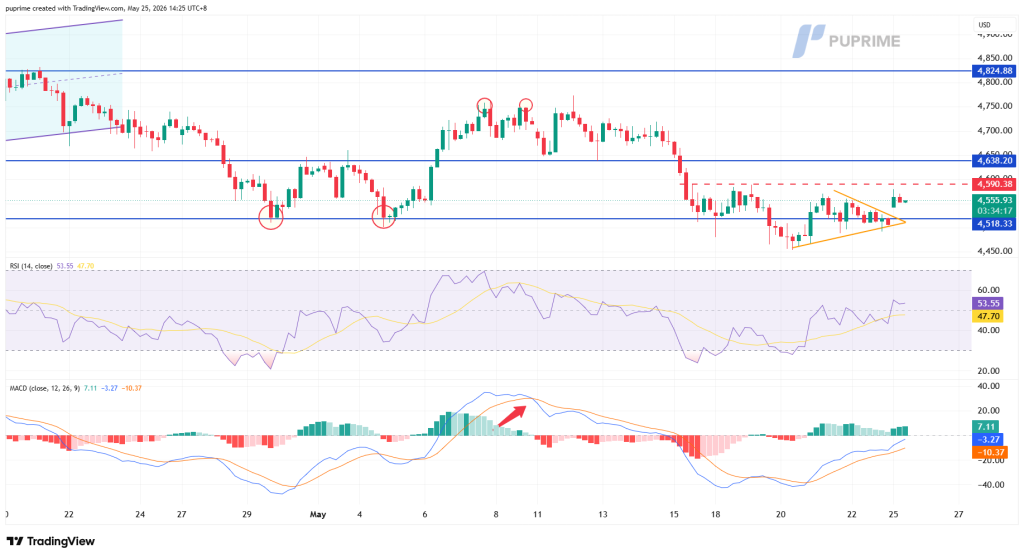
At the same time, the softer dollar and declining Treasury yields provided strong short-term support for gold prices, allowing the precious metal to rebound toward the key psychological $4,600 level after previously pulling back from record highs above the $5,000 region. Although easing geopolitical tensions would normally reduce safe-haven demand for gold more aggressively, the decline in yields and the weaker dollar became the dominant drivers supporting gold’s recovery. Investors also continue maintaining exposure to gold due to persistent macroeconomic uncertainty, long-term inflation concerns, central bank buying activity, and ongoing questions surrounding global fiscal stability.
Despite the recent improvement in market sentiment, both the dollar and gold remain highly sensitive to upcoming economic data and geopolitical headlines. Federal Reserve officials continue maintaining relatively hawkish undertones, with recent FOMC commentary suggesting that interest rates could remain higher for longer if inflation stays elevated. Markets are now closely focused on upcoming PCE inflation data, consumer confidence figures, Treasury yield movements, and additional Fed speeches for clearer guidance regarding future monetary policy. Stronger-than-expected U.S. economic data could quickly revive bullish momentum for the dollar while placing renewed pressure on gold prices through higher yields.
Overall, the near-term outlook for both the U.S. dollar and gold remains heavily dependent on whether US–Iran negotiations successfully progress toward a formal agreement. A confirmed de-escalation scenario would likely continue supporting broader risk appetite, keeping pressure on the dollar while limiting gold’s safe-haven demand. However, any breakdown in talks, renewed Middle East tensions, or stronger U.S. inflation data could quickly reverse sentiment, driving investors back toward defensive assets such as the U.S. dollar and gold.
Technical Analysis
DOLLAR_INDX, H4:
The U.S. Dollar Index (DXY) continues to trade within a broader recovery structure after successfully rebounding from the 97.70 support region earlier this month. Recent price action shows the index consolidating beneath the 99.15–99.50 resistance zone, suggesting that bullish momentum has slowed slightly following the strong mid-May rally. Despite this pause, DXY remains supported above its previous breakout levels, keeping the near-term structure moderately constructive.
Momentum indicators, however, are beginning to soften. The Relative Strength Index (RSI) has declined back toward the lower half of the neutral range, indicating that buying momentum has eased and that upside strength may be cooling in the short term. Meanwhile, the MACD continues to trend lower with the histogram slipping back into negative territory, reflecting weakening bullish momentum and the possibility of near-term consolidation or a mild pullback.
Even so, the broader recovery structure remains intact while price continues to hold above the key 98.80–98.35 support region. A renewed push above 99.15 could allow DXY to retest the stronger resistance zone near 99.50 and potentially extend toward 99.95. Overall, the index appears to be consolidating recent gains, with markets watching closely for confirmation of either renewed upside continuation or a deeper corrective pullback.
Resistance level:99.15, 99.50
Support level: 98.80, 98.35
GOLD, H4:
Gold remains under pressure after failing to sustain its earlier recovery momentum, with price continuing to trade below the key 4,590 resistance region. Recent price action shows XAU/USD attempting to stabilize near the 4,520 support zone following a series of lower highs, suggesting that the broader short-term structure remains cautiously bearish despite the recent rebound attempt.
Momentum indicators, however, are beginning to show signs of gradual improvement. The Relative Strength Index (RSI) has recovered back above the midpoint level, indicating that bearish momentum has eased and that short-term buying pressure may be returning to the market. Meanwhile, the MACD has started to turn higher from negative territory, while the histogram continues to improve modestly, reflecting a potential recovery phase after the recent decline.
Despite this stabilization, gold still faces strong overhead resistance near the 4,590–4,640 region, where previous breakdown levels continue to cap upside momentum. As long as price remains below this zone, the market may continue to trade within a broader consolidation structure. Overall, gold appears to be attempting a short-term recovery, although stronger confirmation is still needed before a broader bullish reversal can be established.
Resistance Levels: 4590.00, 4640.00
Support Levels: 4520.00, 4380.00
Start trading with an edge today
Trade forex, indices, metal, and more at industry-low spreads and lightning-fast execution.
Start trading with deposits as low as $50 on our standard accounts.
Get access to 24/7 support.
Access hundreds of instruments, free educational tools, and some of the best promotions around.
Our products and services are not offered or made available to residents of your jurisdiction. The information on this Website is not directed at persons in your jurisdiction and is not intended as an offer, solicitation, or promotion of our products or services to them.
By clicking “I Understand”, you acknowledge this notice and confirm that you are accessing this Website at your own initiative. Access to this Website does not mean that our products or services are available to you.
Please be advised that our products and services are currently unavailable to residents and entities located in the Philippines.
This restriction is a result of our firm commitment to adhering to applicable legal and regulatory requirements in all jurisdictions where we operate. In line with our internal compliance protocols and evolving global standards, we continuously assess and update access to our platform to ensure full regulatory alignment.
We appreciate your understanding and cooperation.
If you believe this restriction has been applied in error, please contact our support team for further assistance.
Dear Valued Client,
As part of PU Prime’s ongoing commitment to providing a stable and reliable trading environment, please be informed of the following weekly weekend scheduled optimisation activities:
We sincerely apologise for any inconvenience this may cause as we strive to provide you with better service. PU Prime is committed to providing you with the best trading experience and this Weekly Scheduled Optimisation Notice will enable us to ensure that you trade without any unexpected interruptions.
For other upgrades that may involve longer disruptions to your trading, we will announce them ahead of time in a separate announcement.
Important Notice: Please note the Website is intended for individuals residing in jurisdictions where accessing the Website is permitted by law.
Please note that PU Prime and its affiliated entities are neither established nor operating in your home jurisdiction.
By clicking the "Acknowledge" button, you confirm that you are entering this website solely on your own initiative and not as a result of any specific marketing outreach. You wish to obtain information from this website which is provided on a reverse solicitation basis in accordance with the laws of your home jurisdiction.
Please note the Website is intended for individuals residing in jurisdictions where accessing the Website is permitted by law.
Please note that PU Prime and its affiliated entities are neither established nor operating in your home jurisdiction.
By clicking the "Acknowledge" button, you confirm that you are entering this website solely based on your initiative and not as a result of any specific marketing outreach. You wish to obtain information from this website which is provided on reverse solicitation in accordance with the laws of your home jurisdiction.
Ten en cuenta que el sitio web está destinado a personas que residen en jurisdicciones donde el acceso al sitio web está permitido por la ley.
Ten en cuenta que PU Prime y sus entidades afiliadas no están establecidas ni operan en tu jurisdicción de origen.
Al hacer clic en el botón "Aceptar", confirmas que estás ingresando a este sitio web por tu propia iniciativa y no como resultado de ningún esfuerzo de marketing específico. Deseas obtener información de este sitio web que se proporciona mediante solicitud inversa de acuerdo con las leyes de tu jurisdicción de origen.