*Global risk appetite improves as markets price in the planned reopening of the Strait of Hormuz
*Lower energy supply risks ease fears of prolonged inflation pressure
*Asian equities climb to record levels as investor confidence strengthens
*Semiconductor stocks surge as AI and domestic chip production themes remain supportive
Market Summary:
The US dollar and gold markets are currently being driven by the same core macroeconomic themes: the Federal Reserve’s hawkish policy stance, elevated US Treasury yields, and evolving geopolitical developments in the Middle East. At its June meeting, the Federal Reserve kept interest rates unchanged at 3.50%–3.75%, but updated projections indicated that roughly half of policymakers expect at least one additional rate hike before the end of 2026. Fed Chair Kevin Warsh reiterated a data-dependent approach and avoided providing strong forward guidance, reinforcing expectations that policymakers remain focused on persistent inflation rather than preparing for imminent easing. Investors are now closely monitoring upcoming US economic releases, particularly the Core PCE inflation report, PMIs, and GDP revisions, as stronger data could further strengthen the case for tighter monetary policy.
This hawkish outlook has continued to support the US dollar, with the Dollar Index holding near one-year highs as rising Treasury yields increase the attractiveness of dollar-denominated assets. Two-year Treasury yields have climbed to their highest levels since early 2025, while markets continue to price meaningful odds of another rate increase. At the same time, the divergence between US monetary policy and more accommodative central banks, particularly in Japan, has kept USD/JPY above the 161 level and reinforced broad-based demand for the greenback. Geopolitical uncertainty has also added to the dollar’s appeal, as investors seek safe-haven assets amid ongoing concerns surrounding the implementation of the US-Iran peace framework and disruptions affecting the Strait of Hormuz.
For gold, these same factors have created a more challenging environment. A stronger US dollar and elevated real yields have increased the opportunity cost of holding non-yielding assets, limiting bullion’s upside despite recurring safe-haven demand. While geopolitical tensions in the Middle East, including uncertainty over US-Iran negotiations, threats of renewed military action, and instability surrounding the Strait of Hormuz, have periodically driven investors toward gold, those gains have often been offset by expectations that the Federal Reserve will maintain restrictive policy for longer. As a result, gold prices have remained volatile as markets balance defensive buying against the pressure of higher interest rates.
Looking ahead, both assets are expected to remain highly sensitive to incoming economic data and geopolitical developments. A hotter-than-expected inflation reading or stronger US macroeconomic indicators could reinforce expectations of additional Federal Reserve tightening, supporting the US dollar while weighing on gold through higher yields and a firmer currency. Conversely, signs of easing inflation or a meaningful de-escalation in geopolitical tensions could reduce demand for the dollar and provide relief for bullion. Although central bank purchases and reserve diversification continue to offer structural support for gold over the longer term, near-term price action for both markets is likely to be driven primarily by Fed policy expectations, Treasury yield movements, and developments in the Middle East.
Technical Analysis
DXY, H4:
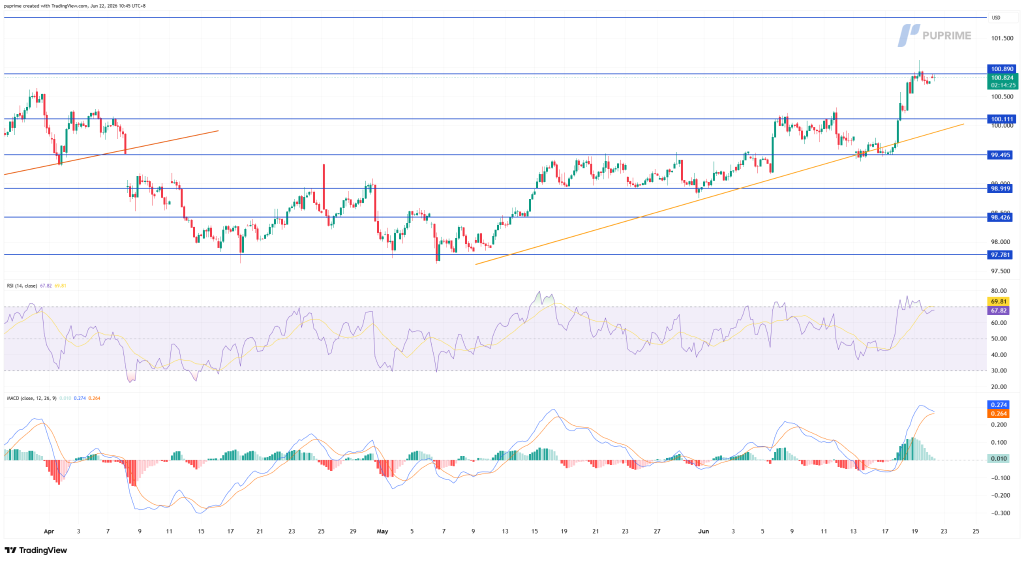
The U.S. Dollar Index (DXY) remains firmly bullish after extending its breakout above the 100.10 resistance level and establishing a new swing high near 100.90. Price is currently consolidating just below resistance at 100.90, suggesting buyers remain in control despite a brief pause following the recent rally. The series of higher highs and higher lows, supported by the ascending trendline, continues to reinforce the broader uptrend structure.
Momentum indicators remain constructive, although signs of short-term exhaustion are beginning to emerge. RSI is holding near 68, hovering just below overbought territory and reflecting strong bullish momentum. Meanwhile, the MACD remains in positive territory with the MACD line above the signal line, but the histogram has started to contract from recent peaks, indicating that upside momentum may be slowing as price approaches resistance.
Overall, the outlook for DXY remains bullish, supported by strong price structure and positive momentum signals. However, with RSI approaching overbought conditions and MACD momentum easing slightly, the index may experience a period of consolidation before attempting another leg higher. A sustained break above 100.90 would confirm continued upside potential, while a pullback toward 100.10 would likely be viewed as a retest of support within the prevailing uptrend.
Resistance Levels: 100.90, 101.85
Support Levels: 100.10, 99.50
GOLD, H4:
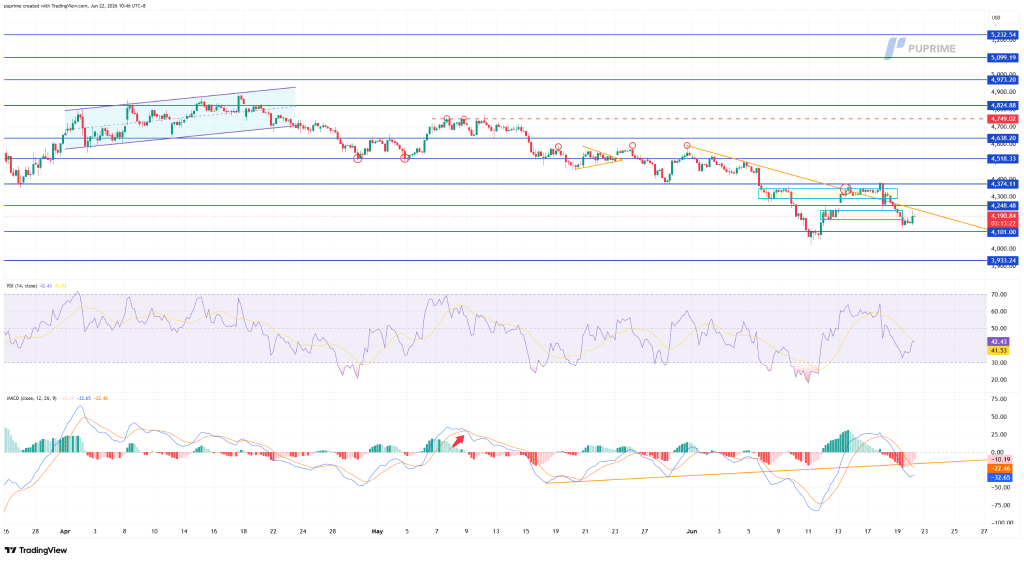
Gold remains under pressure after failing to sustain its breakout above the descending trendline and the 4,375 resistance zone. Recent price action shows another rejection from the trendline resistance, with sellers regaining control and pushing the metal back toward the 4,190–4,250 support region. The broader structure continues to reflect a series of lower highs, suggesting the medium-term bearish trend remains intact.
Momentum indicators also favor the downside. RSI has recovered slightly from oversold territory but remains subdued near 42, indicating that bullish momentum remains limited despite the recent rebound attempt. Meanwhile, MACD remains in negative territory, with the MACD line holding below the signal line and the histogram remaining bearish, signaling that selling pressure continues to dominate.
Overall, the short-term outlook remains bearish while gold trades below both the descending trendline and the 4,250 resistance level. Although prices have stabilized above 4,100 support, momentum indicators have yet to confirm a meaningful trend reversal. Unless buyers can reclaim 4,250 and break the descending trendline, rallies are likely to be viewed as corrective within the broader downtrend, leaving the risk skewed toward another retest of the 4,100 support zone.
Resistance Levels: 4250.00, 4375.00
Support Levels: 4100.00, 3935.00
Start trading with an edge today
Trade forex, indices, metal, and more at industry-low spreads and lightning-fast execution.
Start trading with deposits as low as $50 on our standard accounts.
Get access to 24/7 support.
Access hundreds of instruments, free educational tools, and some of the best promotions around.
Our products and services are not offered or made available to residents of your jurisdiction. The information on this Website is not directed at persons in your jurisdiction and is not intended as an offer, solicitation, or promotion of our products or services to them.
By clicking “I Understand”, you acknowledge this notice and confirm that you are accessing this Website at your own initiative. Access to this Website does not mean that our products or services are available to you.
Please be advised that our products and services are currently unavailable to residents and entities located in the Philippines.
This restriction is a result of our firm commitment to adhering to applicable legal and regulatory requirements in all jurisdictions where we operate. In line with our internal compliance protocols and evolving global standards, we continuously assess and update access to our platform to ensure full regulatory alignment.
We appreciate your understanding and cooperation.
If you believe this restriction has been applied in error, please contact our support team for further assistance.
Dear Valued Client,
As part of PU Prime’s ongoing commitment to providing a stable and reliable trading environment, please be informed of the following weekly weekend scheduled optimisation activities:
We sincerely apologise for any inconvenience this may cause as we strive to provide you with better service. PU Prime is committed to providing you with the best trading experience and this Weekly Scheduled Optimisation Notice will enable us to ensure that you trade without any unexpected interruptions.
For other upgrades that may involve longer disruptions to your trading, we will announce them ahead of time in a separate announcement.
Important Notice: Please note the Website is intended for individuals residing in jurisdictions where accessing the Website is permitted by law.
Please note that PU Prime and its affiliated entities are neither established nor operating in your home jurisdiction.
By clicking the "Acknowledge" button, you confirm that you are entering this website solely on your own initiative and not as a result of any specific marketing outreach. You wish to obtain information from this website which is provided on a reverse solicitation basis in accordance with the laws of your home jurisdiction.
Please note the Website is intended for individuals residing in jurisdictions where accessing the Website is permitted by law.
Please note that PU Prime and its affiliated entities are neither established nor operating in your home jurisdiction.
By clicking the "Acknowledge" button, you confirm that you are entering this website solely based on your initiative and not as a result of any specific marketing outreach. You wish to obtain information from this website which is provided on reverse solicitation in accordance with the laws of your home jurisdiction.
Ten en cuenta que el sitio web está destinado a personas que residen en jurisdicciones donde el acceso al sitio web está permitido por la ley.
Ten en cuenta que PU Prime y sus entidades afiliadas no están establecidas ni operan en tu jurisdicción de origen.
Al hacer clic en el botón "Aceptar", confirmas que estás ingresando a este sitio web por tu propia iniciativa y no como resultado de ningún esfuerzo de marketing específico. Deseas obtener información de este sitio web que se proporciona mediante solicitud inversa de acuerdo con las leyes de tu jurisdicción de origen.