*The British pound remained weak against most G10 currencies despite the UK economy growing 0.6% in Q1 2026, as markets viewed the rebound as potentially temporary.
*Expectations for further Bank of England easing, combined with weak domestic demand, fiscal tightening, and elevated energy costs, continue to limit sterling’s broader appeal.
*Outlook for GBP remains cautious, with upcoming UK inflation, labour market data, and BoE guidance likely to determine sterling’s strength.the path toward $90,000 if regulatory progress and institutional demand remain supportive.
Market Summary
The British Pound has continued to exhibit a bearish trajectory against most of its G10 peers in recent trading sessions. While showing occasional resilience against the US Dollar, GBP has generally underperformed currencies such as the Euro, Swiss Franc, and others within the group. This reflects persistent UK-specific challenges, including policy expectations and external pressures from geopolitical tensions in the Middle East that have influenced energy prices and broader market sentiment.
On May 14, the Office for National Statistics released preliminary Q1 2026 GDP figures, revealing that the UK economy expanded by 0.6% quarter-on-quarter. This outcome aligned closely with economist expectations and marked an acceleration from the revised 0.2% growth recorded in Q4 2025. The services sector led the advance with 0.8% growth, supported by wholesale and retail trade, while production and construction contributed more modestly. Although the data highlights short-term resilience and outpaced several G7 counterparts, analysts caution that the strength may prove temporary. Stockpiling ahead of potential supply disruptions from the Iran-related conflict could mask underlying vulnerabilities, with risks of slower momentum emerging in Q2.
Several factors underpin sterling’s relative weakness. The Bank of England has held its policy rate at 3.75%, yet markets continue to anticipate further easing amid cooling labour market signals and the need to balance sticky inflation risks from higher energy costs. This contrasts with more varied stances among peer central banks, limiting yield support for the pound. Additional headwinds include fiscal tightening measures, subdued domestic demand, and structural concerns that have weighed on investor confidence. These dynamics have contributed to GBP losing ground across several major crosses despite periodic risk-on support in global markets.
Looking ahead in the near term, the outlook for sterling remains cautious with a mild downside bias. The solid Q1 GDP print offers a temporary buffer, but softening growth prospects, potential monetary policy divergence, and lingering effects from elevated energy prices are expected to sustain pressure. Key upcoming releases on inflation, labour market data, and BoE communications will be pivotal in shaping volatility. While selective support may arise from any broad US Dollar weakness, sterling is likely to face continued challenges in outperforming stronger G10 currencies without fresh positive UK catalysts. Investors should monitor geopolitical developments and central bank signals closely for directional cues.
Technical Analysis
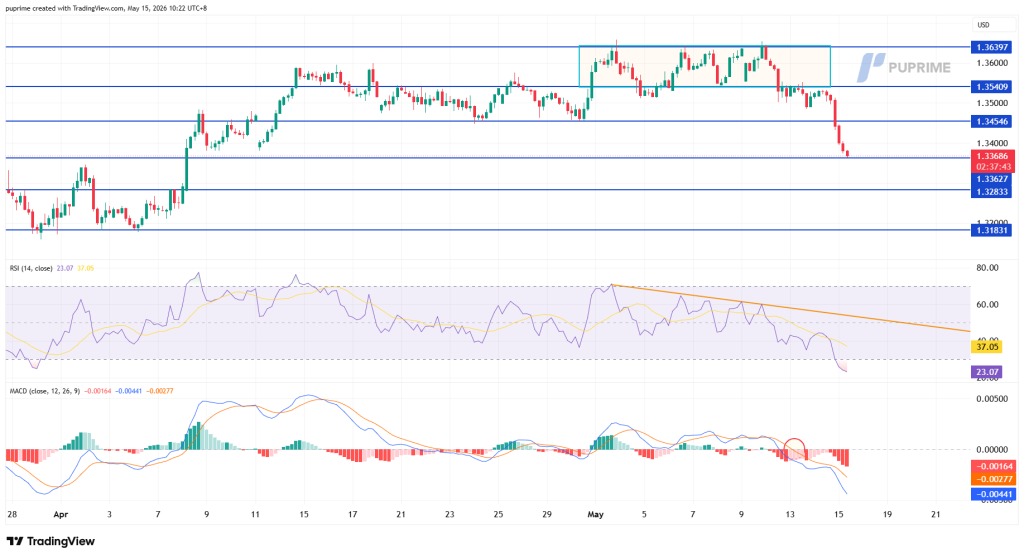
GBPUSD, H4
GBP/USD has broken below its week-long range-bound structure, followed by a sharp decline of more than 1.2% in the previous session—signaling a strong bearish breakout and a clear deterioration in near-term market sentiment.
The downside momentum remains firmly intact, supported by weakening technical indicators. The Relative Strength Index (RSI) has fallen into oversold territory, highlighting the intensity of the recent selling pressure, while the Moving Average Convergence Divergence (MACD) continues to trend lower, reinforcing the prevailing bearish bias.
Given the current momentum profile, the pair may extend its decline toward the immediate support level at 1.3350. A decisive break below this threshold could accelerate downside pressure and expose lower support zones. However, the next key support near 1.3283 is expected to act as a stronger demand area. Should the pair approach this region, the likelihood of a technical rebound or short-term stabilization may increase as oversold conditions begin to develop further.
Overall, while the broader near-term outlook remains bearish, traders should remain alert for potential corrective rebounds near major support levels.
Resistance Levels: 1.3454, 1.3540 Support Levels:1.3283, 1.3183
Start trading with an edge today
Trade forex, indices, metal, and more at industry-low spreads and lightning-fast execution.
Start trading with deposits as low as $50 on our standard accounts.
Get access to 24/7 support.
Access hundreds of instruments, free educational tools, and some of the best promotions around.
Our products and services are not offered or made available to residents of your jurisdiction. The information on this Website is not directed at persons in your jurisdiction and is not intended as an offer, solicitation, or promotion of our products or services to them.
By clicking “I Understand”, you acknowledge this notice and confirm that you are accessing this Website at your own initiative. Access to this Website does not mean that our products or services are available to you.
Please be advised that our products and services are currently unavailable to residents and entities located in the Philippines.
This restriction is a result of our firm commitment to adhering to applicable legal and regulatory requirements in all jurisdictions where we operate. In line with our internal compliance protocols and evolving global standards, we continuously assess and update access to our platform to ensure full regulatory alignment.
We appreciate your understanding and cooperation.
If you believe this restriction has been applied in error, please contact our support team for further assistance.
Dear Valued Client,
As part of PU Prime’s ongoing commitment to providing a stable and reliable trading environment, please be informed of the following weekly weekend scheduled optimisation activities:
We sincerely apologise for any inconvenience this may cause as we strive to provide you with better service. PU Prime is committed to providing you with the best trading experience and this Weekly Scheduled Optimisation Notice will enable us to ensure that you trade without any unexpected interruptions.
For other upgrades that may involve longer disruptions to your trading, we will announce them ahead of time in a separate announcement.
Important Notice: Please note the Website is intended for individuals residing in jurisdictions where accessing the Website is permitted by law.
Please note that PU Prime and its affiliated entities are neither established nor operating in your home jurisdiction.
By clicking the "Acknowledge" button, you confirm that you are entering this website solely on your own initiative and not as a result of any specific marketing outreach. You wish to obtain information from this website which is provided on a reverse solicitation basis in accordance with the laws of your home jurisdiction.
Please note the Website is intended for individuals residing in jurisdictions where accessing the Website is permitted by law.
Please note that PU Prime and its affiliated entities are neither established nor operating in your home jurisdiction.
By clicking the "Acknowledge" button, you confirm that you are entering this website solely based on your initiative and not as a result of any specific marketing outreach. You wish to obtain information from this website which is provided on reverse solicitation in accordance with the laws of your home jurisdiction.
Ten en cuenta que el sitio web está destinado a personas que residen en jurisdicciones donde el acceso al sitio web está permitido por la ley.
Ten en cuenta que PU Prime y sus entidades afiliadas no están establecidas ni operan en tu jurisdicción de origen.
Al hacer clic en el botón "Aceptar", confirmas que estás ingresando a este sitio web por tu propia iniciativa y no como resultado de ningún esfuerzo de marketing específico. Deseas obtener información de este sitio web que se proporciona mediante solicitud inversa de acuerdo con las leyes de tu jurisdicción de origen.