Every roundup crowns a different best CFD trading platform, and they cannot all be right. The truth is simpler: the right platform depends on how you trade. A scalper who opens twenty positions a day and a beginner placing one small trade a week are shopping for different things, so the same broker cannot top both lists.
CFD trading also carries real risk. Most retail traders lose money, because a contract for difference is a leveraged product that magnifies losses as readily as gains. That is worth saying before any comparison, not after.
So this guide does not rank platforms one to five. It sorts five widely compared options by the trader each one suits, and lays out the cost, execution, and regulatory detail you need to judge them yourself. Cost, execution speed, leverage limits, and platform choice matter differently depending on your style, and the aim here is to help you match those factors to how you actually trade.
The Right CFD Trading Platform for Your Style
Here is the short version before the details. No single platform wins outright; each fits a different kind of trader.
Trading style
Platform
Strong for
New traders
Plus500
Simple interface, low minimums, demo access
MT4 and MT5 traders
PU Prime
MetaTrader support across four account types
Cost-sensitive, high-volume
Pepperstone
Raw-spread plus commission pricing
Wide market access
IG
Broad instrument range and research
Technical charting
CMC Markets
Deep charting and platform tools
Read each entry below in full before deciding. Broker conditions change often, so treat spreads and fees as figures to confirm on the provider’s own site, not fixed facts.
How CFD Platforms Charge You
Headline spreads rarely tell you the true cost of a trade. What you actually pay is a mix of the spread, any commission, and financing charges if you hold overnight. Compare those three together, or you will pick a platform that looks cheap and is not.
Here is a concrete example. Say you trade one standard lot of EUR/USD. On a spread-only account with a 1.3 pip spread, you pay roughly USD 13 in spread and nothing else to open and close. On a raw-spread account with a 0.0 pip spread and a USD 7 round-turn commission, you pay closer to USD 7 plus whatever the raw spread widens to. Which is cheaper depends on how tight the raw spread runs and how often you trade.
Spread-Only Pricing
A spread-only account bundles the entire cost into the spread, with no separate commission. You see one number, the gap between the buy and sell price, and that is what you pay to trade.
This suits beginners and lower-frequency traders. There is nothing extra to calculate, and small position sizes rarely make the wider spread hurt. The trade-off is that spread-only pricing tends to cost more per trade once your volume climbs, because the markup is baked into every position.
Commission-Based Pricing
A commission-based account, often called raw-spread or ECN, quotes tighter spreads from underlying liquidity and charges a fixed commission per lot on top. A typical structure is a spread from 0.0 pips plus a commission of roughly USD 2 to USD 7 per round-turn lot, depending on the account.
For frequent, higher-volume traders, the total cost usually comes out lower, because the raw spread plus a known commission beats a wider all-in spread paid many times over. For someone trading occasionally in small size, the commission can outweigh the savings. Work the maths on your own typical trade before assuming raw is cheaper.
Overnight and Swap Fees
Hold a CFD position past the daily cut-off and you pay or receive a swap, the financing charge for keeping a leveraged position open overnight. On a short-term trade closed the same day, swaps do not apply. On a position held for weeks, they can quietly become the highest cost you face.
Swap-free, or Islamic, account versions remove overnight swaps for eligible clients, which matters if your strategy holds trades for long stretches. If you trade longer timeframes, price the swap into your plan the same way you price the spread.
Execution, Markets and Tools to Compare
Cost is only half the decision. The rest comes down to how well a platform fills your orders, how many markets it reaches, and what tools it gives you to trade them. Regulation and leverage are their own topic and come later; this section covers the non-cost conditions that separate one platform from another.
Execution Speed and Slippage
Execution quality is how faithfully your order fills at the price you expected. In calm markets, almost any platform looks fine. In fast ones, around a news release, the differences show up as slippage, where your fill lands worse than the price you clicked, and as requotes, where the platform asks you to accept a new price.
For scalpers and news traders, this is the whole game, because a few pips of slippage on every trade erodes an edge quickly. Some brokers publish execution statistics, and where they do not, a demo account run during a volatile session tells you more than any marketing figure.
Market and Instrument Range
Instrument range is the breadth of what you can trade: forex pairs, indices, commodities, shares, and crypto CFDs. A trader who sticks to a handful of major currency pairs needs far less range than one who rotates across asset classes.
Wider is not automatically better. A platform with thousands of instruments you never touch is no more useful than a focused one that covers your markets well. Match the range to what you actually trade, and if you want to trade shares as CFDs, check that the specific names you follow are listed.
Charting and MetaTrader Support
The platform is the software you place trades through, and it shapes your day more than any other single factor. The two questions that matter most are charting depth, meaning the indicators, drawing tools, and timeframes on offer, and platform type: MetaTrader 4, MetaTrader 5, or a broker’s own proprietary software.
MT4 and MT5 are the industry-standard choice for traders who rely on custom indicators, expert advisors, or a familiar workflow carried over from another broker. Proprietary platforms can be cleaner and easier for beginners, but they lock you into one broker’s ecosystem. Decide which trade-off you prefer before you commit, and if you want a fuller checklist, our guide on what to look for in a CFD platform runs through the rest.
5 Best CFD Trading Platforms for Different Trading Styles
Each platform below sits under the trading style it fits, with balanced pros and cons. None is crowned the overall winner, because the right pick is the one that matches how you trade. If you would rather learn the method than take a shortlist, our guide on how to find a CFD broker walks through it. Broker-to-category assignments are provisional; confirm current spreads, fees, and features on each provider’s own site before acting.
Best for New Traders: Plus500
Plus500 pairs a stripped-back, proprietary interface with low minimum deposits and a full-featured demo, which makes it an easy first platform for someone still learning how CFDs behave. The layout hides most of the complexity, so a beginner is not overwhelmed on day one.
The trade-off is that same simplicity. Plus500 runs on its own platform rather than MetaTrader, so there is no MT4 or MT5, no expert advisors, and less depth for a trader who later wants advanced charting or automation. It is a strong place to start and a platform many traders outgrow. Confirm current spreads, product availability, and regulatory status for your country before opening an account.
Best for MT4 and MT5 Trading: PU Prime
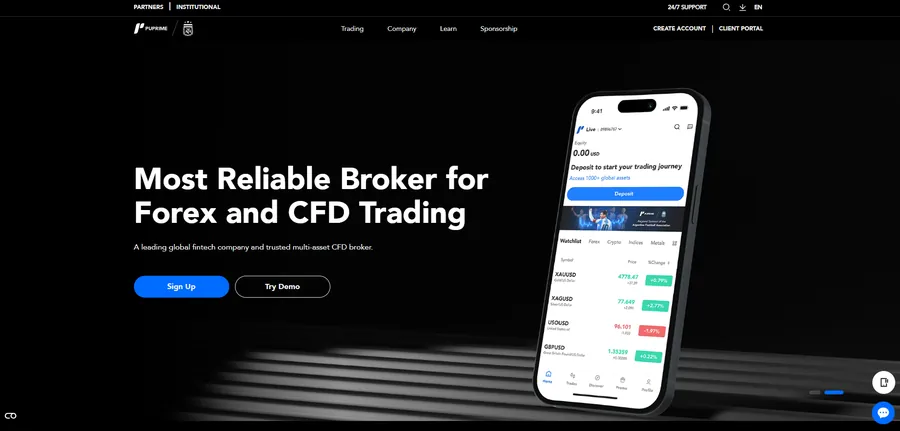
PU Prime supports both MetaTrader 4 and MetaTrader 5 alongside its own PU Prime App and PU Web Trader, which suits traders who want the standard MetaTrader workflow, custom indicators, and expert advisors. It offers four account types, the Cent account, Standard, Prime, and ECN, spanning commission-free spread pricing and raw-spread-plus-commission pricing, plus a demo account for practising without real money. PU Prime reports order execution of around 15 milliseconds on its infrastructure.
Two things to weigh. First, regulation: PU Prime is regulated by FSCA (South Africa), the FSA (Seychelles), the FSC (Mauritius), and the CMA (UAE), so the entity you would trade under and the protections that come with it depend on your country of residence. Second, leverage runs up to 1:1000 depending on the account and entity, which magnifies losses as much as gains. Confirm current account minimums, spreads, and leverage caps for the account you plan to open.
Best for Low Trading Costs: Pepperstone
Pepperstone is built around a raw-spread-plus-commission model that tends to reward frequent, higher-volume trading, where tight underlying spreads and a fixed per-lot commission add up to less than a wider all-in spread paid across many trades. Scalpers and active day traders are the natural fit.
The cost advantage narrows for lower-frequency traders, since the commission is charged whether you trade once a week or fifty times a day, and occasional traders in small size may find a spread-only account simpler and no more expensive. As with any broker, verify the current commission, spreads, and available markets before you judge the true cost for your style.
Best for Market Range: IG
IG offers one of the broader instrument ranges in the market, spanning forex, indices, commodities, shares, and more, backed by substantial research and analysis tools. A trader who rotates across asset classes, or who wants deep market coverage in one account, is well served.
Breadth has a cost. A large, feature-rich platform can feel heavy to a beginner who only trades a couple of markets, and pricing on some products may not be the tightest available. Match the range to what you actually trade rather than paying for coverage you will not use, and confirm current spreads and product availability before deciding.
Best for Advanced Charting: CMC Markets
CMC Markets is known for deep charting and platform tooling: a wide indicator set, granular timeframes, and drawing and analysis features that suit technical traders who spend their time reading price action. If your process leans heavily on charts, the depth here is the draw.
That depth can be more than a casual trader needs, and the learning curve on a full-featured charting platform is steeper than a stripped-back app. Beginners may prefer to grow into it. Check the current instrument list, spreads, and platform features against your own requirements before committing.
Leverage Limits and Regulation
Before you choose a platform, check the leverage limits and rules that apply where you live, because these change what you can actually access. Brokers hold different licences in different markets, so the caps, the entity you trade under, and the protections available to you can vary by jurisdiction. Confirm what applies to you before opening an account.
Retail Leverage Caps
In many major regulated markets, retail CFD leverage is capped, commonly ranging from around 30:1 on major currency pairs down to 2:1 on more volatile assets such as cryptocurrencies. Regulated brokers in these markets are also typically required to provide negative balance protection, so a retail client cannot lose more than their account balance, alongside strict marketing and risk-warning requirements.
Investor Protections
Across many regulated markets, comparable frameworks set retail leverage caps at similar levels, around 30:1 on majors and tighter on riskier instruments, and mandate standardised risk warnings and negative balance protection for retail clients. The exact caps, the entity you trade under, and the protections that apply depend on the rules where you live.
Checking Availability in Your Region
Broker availability varies from one market to another, and some international brokers are not registered to serve residents of every country or region. That affects both access and the protections that apply. Confirm a platform’s registration status where you live before treating it as available to you.
Frequently Asked Questions
A few quick answers to the questions traders ask most when comparing CFD platforms.
Is CFD Trading Legal and Regulated
Yes. CFD trading is legal and regulated in most major markets, where financial regulators set leverage caps, risk-warning rules, and protections for retail clients. Trading through a regulated, authorised provider means those rules apply to your account.
Do CFD Platforms Charge to Open an Account
Most CFD accounts are free to open, with no upfront account fee. Costs arise once you trade, through spreads, any per-lot commission, and overnight swap charges on positions held past the daily cut-off, plus possible inactivity or withdrawal fees depending on the broker.
What Is the Difference Between a CFD Broker and a Trading Platform
The broker provides the regulated account and executes your trades, while the platform is the software you use to place them, such as MT4, MT5, or a proprietary app. One broker can offer several platforms, and the same platform can be offered by many brokers.
Can I Practise on a CFD Platform Before Risking Money
Yes. Most platforms offer a demo account funded with virtual money, which lets you learn the software and test a strategy. A demo shows how the platform works but not the emotional pressure of real money or the exact fills you would get live, so treat it as practice, not a guarantee of live results.
What Happens to My Money If a Platform Shuts Down
Regulated brokers are generally required to hold client funds in segregated accounts, separate from the firm’s own money, so client cash is not used to run the business. In some jurisdictions a compensation scheme may cover eligible clients up to a limit if the firm fails. The exact protection depends on the regulator and the entity you trade under, so confirm it for your account.
Conclusion
There is no single best CFD trading platform, only the one that fits how you trade. A beginner wants a simple interface and a demo; a high-volume trader wants raw spreads and fast fills; a technical trader wants deep charts; and everyone should start with the leverage rules and broker authorisation that apply in their own country.
Whichever way you lean, the sensible next step is to test rather than commit. Open a demo account, run your actual strategy through the platform for a week, and see how the costs, execution, and tools hold up before putting real money at risk.
Open a trading account
Once you have compared conditions, checked the rules that apply where you live, and understood the risks, you can open a live PU Prime forex and CFD account. Open an account here.
Disclaimer: CFD trading is high risk and is not suitable for everyone. Most retail accounts lose money, so never trade with funds you cannot afford to lose, and make sure you understand how leverage magnifies both gains and losses before you begin.
Start trading with an edge today
Trade forex, indices, metal, and more at industry-low spreads and lightning-fast execution.
Start trading with deposits as low as $50 on our standard accounts.
Get access to 24/7 support.
Access hundreds of instruments, free educational tools, and some of the best promotions around.
Our products and services are not offered or made available to residents of your jurisdiction. The information on this Website is not directed at persons in your jurisdiction and is not intended as an offer, solicitation, or promotion of our products or services to them.
By clicking “I Understand”, you acknowledge this notice and confirm that you are accessing this Website at your own initiative. Access to this Website does not mean that our products or services are available to you.
Please be advised that our products and services are currently unavailable to residents and entities located in the Philippines.
This restriction is a result of our firm commitment to adhering to applicable legal and regulatory requirements in all jurisdictions where we operate. In line with our internal compliance protocols and evolving global standards, we continuously assess and update access to our platform to ensure full regulatory alignment.
We appreciate your understanding and cooperation.
If you believe this restriction has been applied in error, please contact our support team for further assistance.
Dear Valued Client,
As part of PU Prime’s ongoing commitment to providing a stable and reliable trading environment, please be informed of the following weekly weekend scheduled optimisation activities:
We sincerely apologise for any inconvenience this may cause as we strive to provide you with better service. PU Prime is committed to providing you with the best trading experience and this Weekly Scheduled Optimisation Notice will enable us to ensure that you trade without any unexpected interruptions.
For other upgrades that may involve longer disruptions to your trading, we will announce them ahead of time in a separate announcement.
Important Notice: Please note the Website is intended for individuals residing in jurisdictions where accessing the Website is permitted by law.
Please note that PU Prime and its affiliated entities are neither established nor operating in your home jurisdiction.
By clicking the "Acknowledge" button, you confirm that you are entering this website solely on your own initiative and not as a result of any specific marketing outreach. You wish to obtain information from this website which is provided on a reverse solicitation basis in accordance with the laws of your home jurisdiction.
Please note the Website is intended for individuals residing in jurisdictions where accessing the Website is permitted by law.
Please note that PU Prime and its affiliated entities are neither established nor operating in your home jurisdiction.
By clicking the "Acknowledge" button, you confirm that you are entering this website solely based on your initiative and not as a result of any specific marketing outreach. You wish to obtain information from this website which is provided on reverse solicitation in accordance with the laws of your home jurisdiction.
Ten en cuenta que el sitio web está destinado a personas que residen en jurisdicciones donde el acceso al sitio web está permitido por la ley.
Ten en cuenta que PU Prime y sus entidades afiliadas no están establecidas ni operan en tu jurisdicción de origen.
Al hacer clic en el botón "Aceptar", confirmas que estás ingresando a este sitio web por tu propia iniciativa y no como resultado de ningún esfuerzo de marketing específico. Deseas obtener información de este sitio web que se proporciona mediante solicitud inversa de acuerdo con las leyes de tu jurisdicción de origen.