Forex Compounding Calculator: See How Your Account Really Grows
A forex compounding calculator shows how your trading account grows when you reinvest your profits instead of withdrawing them.
You enter your starting balance, your gain per period, and the number of periods you want to project.
The calculator then applies each gain on top of the last, so your account grows faster over time.
Free Tool
Forex Compounding Calculator
See how a trading account can grow when you reinvest your gains. Switch to Realistic mode to see what happens when you factor in the losing periods every trader actually has.
This calculator is for illustration only. It assumes a constant gain per period, which no real trading account achieves. Past or projected performance does not guarantee future results. Trading CFDs carries a high risk of loss. PU Prime is regulated by the FSA (Seychelles, SD050) and ASIC (410681).
Use the free calculator above to run your own numbers.
Then read on, because there is one thing most compounding calculators will not tell you, and it matters more than the final number they show.
Key Overviews
Compounding means earning gains on your previous gains, not just your starting balance.
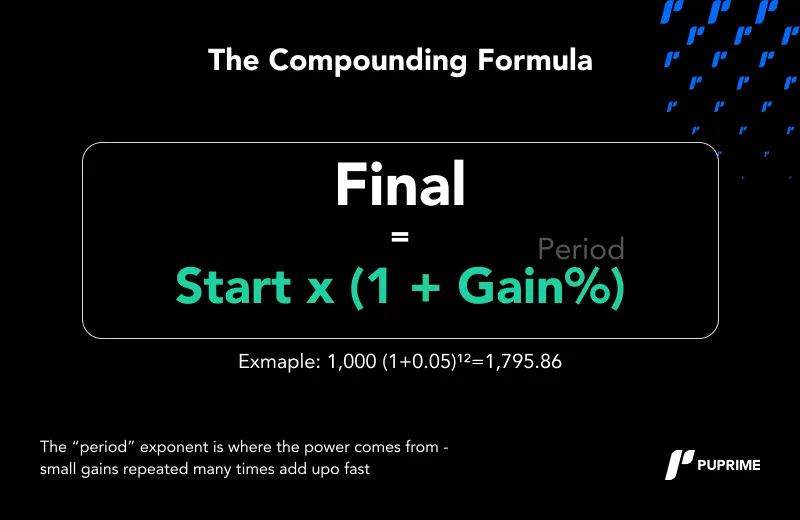
The formula is simple: Final balance = Starting balance × (1 + gain%) raised to the number of periods.
Small, steady gains compound into large numbers over time — but only if you avoid big losses.
Most compounding calculators show an unrealistic “perfect” scenario where you never have a losing period.
Our calculator has a realistic mode that accounts for downtime, so you can plan with honest numbers.
A single bad month can undo many good ones. This is why risk management matters more than chasing high returns.
How Compounding Works
Compounding is simple to understand with an example.
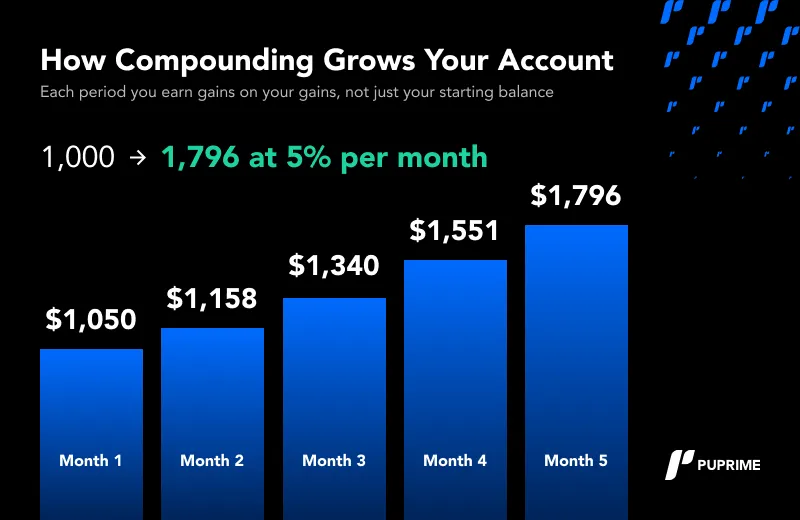
Say you start with $1,000 and you make a 5% gain in your first month. You now have $1,050.
In month two, you make another 5% — but this time the 5% is calculated on $1,050, not $1,000. So you earn $52.50 instead of $50.
That extra $2.50 might not sound like much.
But repeat this every month, and the effect builds.
By month twelve, your $1,000 has grown to $1,795.86 — not the $1,600 you would get if you earned a flat $50 every month.
That gap is the power of compounding.
The Compounding Formula
You do not need to do math by hand — the calculator does it for you.
But it helps to understand what is happening under the hood.
The key part is the exponent — the number of periods. That is where growth comes from.
A 5% gain once is just 5%. But a 5% gain repeated 12 times, each building on the last, adds up to nearly 80%.
The longer you compound and the more consistent your gains, the more dramatic the effect.
The Honest Part: Optimistic vs Realistic
Here is what almost no other compounding calculator will tell you: the numbers they show are fantasy numbers.
Every standard compounding calculator assumes you make the exact same gain every single period, forever, with no losing periods.
No real trading account works like that. Even the best traders in the world have losing weeks and losing months.
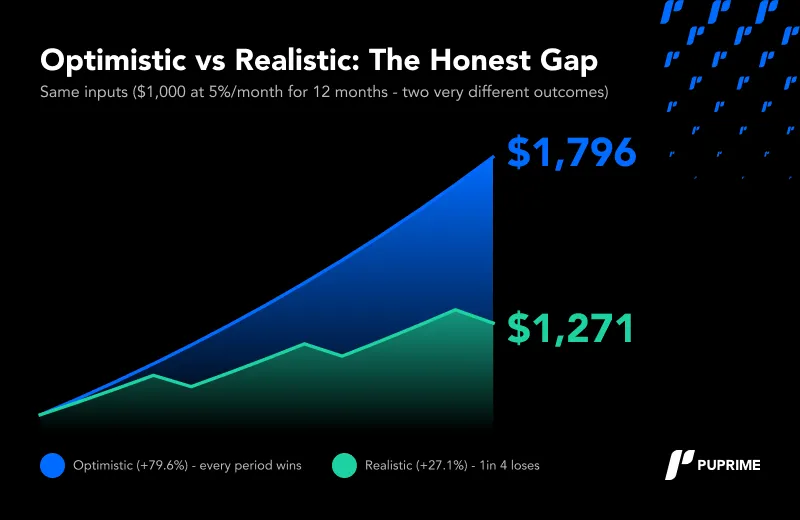
Optimistic mode shows the perfect scenario — every period is a winner.
Realistic mode assumes about 1 in every 4 periods is a loss, and that your winning periods come in below your target. This is much closer to how real trading actually works.
Look at the gap. With the exact same inputs — $1,000 starting balance, 5% monthly target, 12 months — the optimistic view shows $1,796.
The realistic view shows $1,271. That is a $525 difference, and the realistic number is the one you should actually plan around.
This is not us being negative. It is us being honest.
A calculator that only shows you the dream is setting you up for disappointment, or worse, encouraging you to risk money you cannot afford to lose because the projected returns look so easy.
Why One Bad Period Hurts So Much
Compounding works in both directions.
The same math that grows your account also shrinks it when you lose.
Here is the painful part: a loss hurts more than an equal gain helps.
If you lose 50% of your account, you do not need a 50% gain to recover — you need a 100% gain.
If your $1,000 drops to $500, getting back to $1,000 means doubling what you have left.
This is why risk management matters more than chasing big returns.
Protecting your account from large losses is what lets compounding do its work over time.
A trader who makes a steady 3% months and rarely has a big loss will usually end up far ahead of one who swings for 20% months and blows up twice a year.
How to Use the Compounding Calculator
The calculator at the top of this page is simple to use:
Enter your starting balance. This is how much you are starting with. With PU Prime, you can open a Standard account for as little as $50.
Enter your gain per period. This is your realistic target return for each period. Be honest here. A 3–5% monthly gain is ambitious but achievable for a disciplined trader. Anyone promising 20% a month is selling a fantasy.
Choose your number of periods and period length. Daily, weekly, monthly, or yearly. Most traders plan in months.
Switch between Optimistic and Realistic. Always check the realistic number. That is the one to plan around.
A Realistic Gain Target for Beginners
If you are new to trading, here is some honest guidance on what to put in the gain field.
Professional fund managers are happy with 15–20% per year.
Not per month — per year. That puts the “5% per month” figure (which compounds to nearly 80% a year) into perspective. It is at the very top end of what is realistic, and only for skilled, disciplined traders.
For your first year, a more honest target is simply not to lose money while you learn.
If you can finish your first year with your account intact and a working strategy, you are ahead of most beginners. The big compounding numbers come later, once you are consistent.
The best way to find your realistic gain rate is to practise on a demo account first.
Trade for a few months, track your actual monthly returns, and use that real number in the calculator.
That gives you a projection based on your real performance, not a guess.
Frequently Asked Questions
What is a forex compounding calculator?
A forex compounding calculator is a tool that shows how your trading account grows when you reinvest your profits. You enter a starting balance, a gain percentage per period, and the number of periods. It then applies each gain to the previous balance and shows your projected final amount.
Is compounding realistic in forex trading?
Compounding is real, but the smooth, perfect growth that most calculators show is not. Real trading has losing periods. Our realistic mode factors these in. Compounding works best for disciplined traders who avoid large losses and grow their accounts steadily over time.
What is a realistic monthly return in forex?
A realistic target for a skilled, disciplined trader is around 3–5% per month, and even that is ambitious. Professional fund managers often aim for 15–20% per year. Anyone promising 20% or more per month is not being honest about the risks involved.
Can I lose money even with compounding?
Yes. Compounding works in both directions. Losing periods shrinks your account, and a large loss is hard to recover from because you need a bigger percentage gain to get back to where you started. This is why risk management is more important than chasing high returns.
What percentage should I enter in the calculator?
Use a realistic number based on your own results. If you have a demo or live track record, use your actual average return per period. If you are just starting, try a conservative figure like 2–3% per month and check the realistic mode to see a planning-friendly projection.
How is compounding different from simple interest?
Simple interest pays you a fixed amount based only on your starting balance. Compounding pays you on your growing balance, so each period you earn slightly more than the last. Over time, compounding produces much larger results than simple interest
Start trading with an edge today
Trade forex, indices, metal, and more at industry-low spreads and lightning-fast execution.
Start trading with deposits as low as $50 on our standard accounts.
Get access to 24/7 support.
Access hundreds of instruments, free educational tools, and some of the best promotions around.
Important Notice: Please note the Website is intended for individuals residing in jurisdictions where accessing the Website is permitted by law.
Please note that PU Prime and its affiliated entities are neither established nor operating in your home jurisdiction.
By clicking the "Acknowledge" button, you confirm that you are entering this website solely on your own initiative and not as a result of any specific marketing outreach. You wish to obtain information from this website which is provided on a reverse solicitation basis in accordance with the laws of your home jurisdiction.
Please note the Website is intended for individuals residing in jurisdictions where accessing the Website is permitted by law.
Please note that PU Prime and its affiliated entities are neither established nor operating in your home jurisdiction.
By clicking the "Acknowledge" button, you confirm that you are entering this website solely based on your initiative and not as a result of any specific marketing outreach. You wish to obtain information from this website which is provided on reverse solicitation in accordance with the laws of your home jurisdiction.
Ten en cuenta que el sitio web está destinado a personas que residen en jurisdicciones donde el acceso al sitio web está permitido por la ley.
Ten en cuenta que PU Prime y sus entidades afiliadas no están establecidas ni operan en tu jurisdicción de origen.
Al hacer clic en el botón "Aceptar", confirmas que estás ingresando a este sitio web por tu propia iniciativa y no como resultado de ningún esfuerzo de marketing específico. Deseas obtener información de este sitio web que se proporciona mediante solicitud inversa de acuerdo con las leyes de tu jurisdicción de origen.