*April CPI surged to 3.8% YoY, the highest since May 2023, reinforcing concerns that inflation may stay elevated for longer.
*Stronger inflation data reduced expectations for near-term Fed rate cuts and even revived speculation of another potential rate hike later in 2026.
*Escalating US-Iran tensions and uncertainty surrounding the Strait of Hormuz boosted safe-haven demand for dollar amid rising global volatility.
Market Summary
The US dollar and gold markets are currently being driven by the same core macro themes: persistent inflation, escalating geopolitical tensions, and shifting Federal Reserve expectations. April 2026 CPI came in significantly hotter than expected, rising 0.6% month-over-month and 3.8% year-over-year as the highest annual inflation reading since May 2023 while Core CPI accelerated to 2.8% YoY. Much of the inflation pressure came from surging energy prices linked to ongoing Middle East instability and fears surrounding disruptions in the Strait of Hormuz. The stronger inflation data sharply reduced expectations for near-term Fed rate cuts, with some traders even beginning to price in the possibility of another rate hike later this year. This pushed US Treasury yields higher and provided fresh support for the US Dollar Index (DXY), which rebounded above the 98.00–98.30 region after previously hovering near multi-week lows.
At the same time, geopolitical tensions between the United States and Iran have significantly intensified market uncertainty. President Donald Trump rejected Iran’s latest peace proposal as “totally unacceptable,” warning that the ceasefire remains “on life support,” while reports emerged of potential renewed military actions and discussions surrounding naval escorts through the Strait of Hormuz. Since roughly 20% of global oil flows pass through Hormuz, markets remain highly sensitive to any escalation headlines. This geopolitical backdrop has reinforced safe-haven demand for the US dollar, especially as investors seek liquidity and protection amid rising volatility across global markets. The dollar has therefore benefited from both higher yields and defensive positioning, helping USD/JPY remain elevated near the 157.50 region while EUR/USD and GBP/USD softened further.
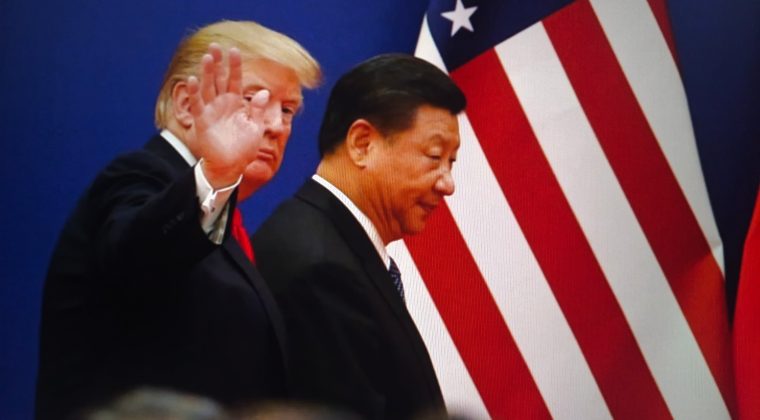
Gold, meanwhile, has entered a more complex macro environment. Normally, rising geopolitical risks and military tensions would strongly support bullion prices. However, the latest inflation shock and resulting surge in Treasury yields have partially offset gold’s safe-haven appeal. Gold initially retraced after forming a technical double-top pattern, pressured by the stronger dollar and higher real yields, falling from highs near $4,773 toward the $4,670–4,700 region. Nevertheless, prices later stabilized and entered a new consolidation range as geopolitical uncertainty continued to provide underlying support. Investors remain cautious ahead of the upcoming Trump–Xi summit in Beijing, where discussions surrounding trade, Iran, Taiwan, critical minerals, and broader geopolitical coordination could significantly influence risk sentiment and safe-haven flows globally.
Despite the short-term pressure from rising yields, gold fundamentals remain structurally supported by ongoing geopolitical instability, sticky inflation risks, central bank buying activity, and growing concerns over long-term global economic fragmentation. Markets are increasingly treating gold not only as a geopolitical hedge, but also as a highly interest-rate-sensitive macro asset. For now, the “higher-for-longer” Fed narrative is temporarily capping upside momentum, while continued uncertainty surrounding Iran, the Strait of Hormuz, and US-China relations continues to prevent deeper downside pressure. Going forward, traders will closely monitor further inflation data, Federal Reserve commentary, developments from the Trump–Xi meeting, and any escalation or de-escalation in Middle East tensions, as these factors are likely to determine the next major directional move for both the US dollar and gold.
Technical Analysis
GOLD, H4:
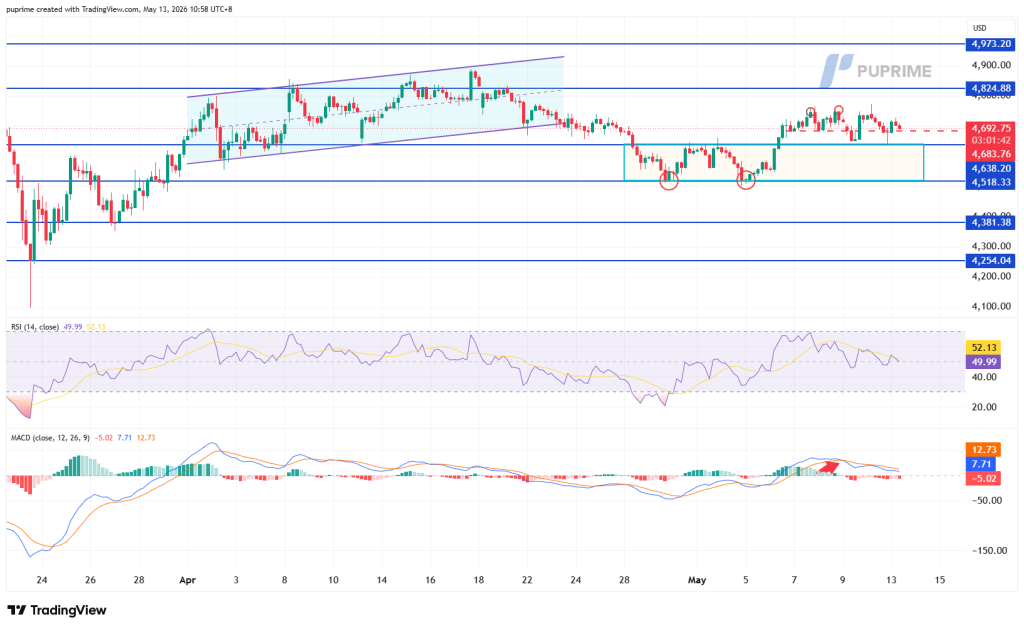
Gold prices remain in a broader consolidation structure after the strong rebound from the key support zone near 4,520. The recent price action shows XAUUSD struggling to sustain momentum above the 4,700 resistance region, with multiple rejection candles forming near the recent highs, suggesting that bullish momentum has started to moderate in the near term.
Despite the temporary loss of upside momentum, gold continues to hold above the important 4,640 support area, indicating that buyers are still defending the broader recovery structure following the earlier rebound from April lows. The market is currently moving within a relatively tight consolidation range as traders assess whether price can build enough momentum for another breakout attempt.
Momentum indicators are also reflecting this more neutral short-term environment. The Relative Strength Index (RSI) has eased back toward the midpoint near 50, signaling that the previous bullish momentum has weakened and that market sentiment is becoming more balanced. Meanwhile, the MACD has started to flatten, with bullish momentum fading after the recent upward move, pointing to slowing upside strength in the near term.
Overall, gold appears to be entering a consolidation phase after its recent recovery rally, with price action remaining sensitive around the 4,640–4,700 range as markets await clearer directional confirmation.
Resistance Levels: 4765.00, 4825.00
Support Levels: 4685.00, 4520.00
DXY, H4:
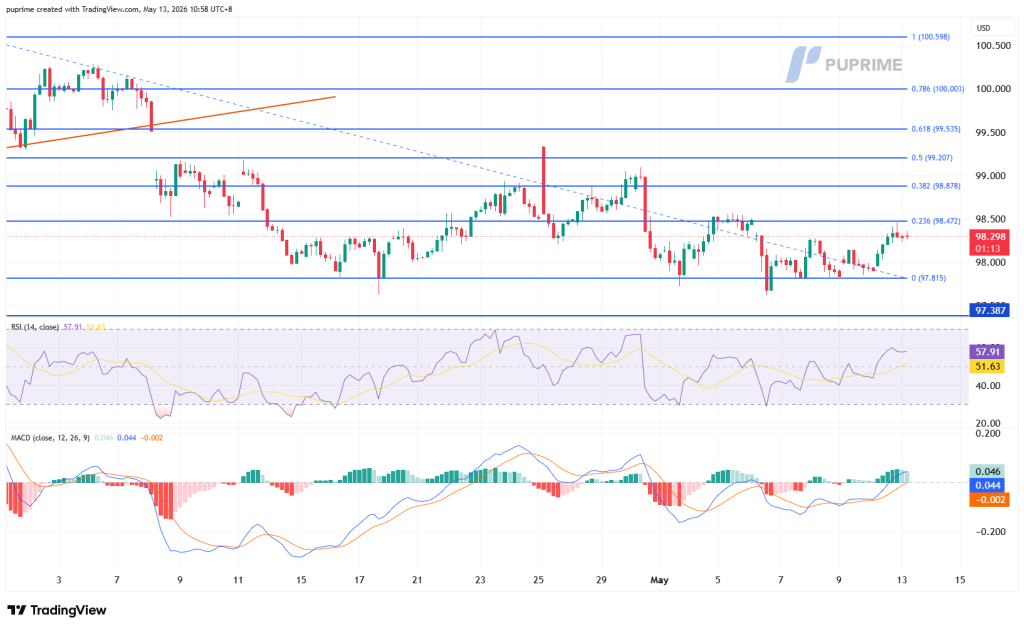
The U.S. Dollar Index (DXY) continues to trade within a broader short-term bearish structure although recent price action suggests that downside momentum has started to stabilize. After previously remaining capped below the descending trendline resistance that has guided the decline since early April, the index is now attempting to recover toward the key 98.50 resistance area following multiple rebounds from the 97.80 support zone.
The latest recovery attempt indicates that selling pressure may be gradually weakening in the near term, especially as price continues to hold above recent lows despite several downside tests. However, DXY still remains below the broader descending resistance structure, keeping the overall market tone cautious unless a clearer breakout develops.
Momentum indicators are beginning to show signs of improvement. The Relative Strength Index (RSI) has moved back above the midpoint level, suggesting that bearish momentum has faded and short-term buying pressure is gradually returning. Meanwhile, the MACD is stabilizing near the neutral zone with histogram bars turning positive again, reflecting improving momentum conditions following the recent consolidation phase.
Overall, DXY appears to be attempting a short-term recovery after an extended decline, with market participants closely monitoring whether the index can establish stronger upside momentum above nearby resistance levels or remain trapped within the broader bearish trend structure.
Resistance Levels:98.50, 98.90
Support Levels: 97.80, 97.40
Start trading with an edge today
Trade forex, indices, metal, and more at industry-low spreads and lightning-fast execution.
Start trading with deposits as low as $50 on our standard accounts.
Get access to 24/7 support.
Access hundreds of instruments, free educational tools, and some of the best promotions around.
Our products and services are not offered or made available to residents of your jurisdiction. The information on this Website is not directed at persons in your jurisdiction and is not intended as an offer, solicitation, or promotion of our products or services to them.
By clicking “I Understand”, you acknowledge this notice and confirm that you are accessing this Website at your own initiative. Access to this Website does not mean that our products or services are available to you.
Please be advised that our products and services are currently unavailable to residents and entities located in the Philippines.
This restriction is a result of our firm commitment to adhering to applicable legal and regulatory requirements in all jurisdictions where we operate. In line with our internal compliance protocols and evolving global standards, we continuously assess and update access to our platform to ensure full regulatory alignment.
We appreciate your understanding and cooperation.
If you believe this restriction has been applied in error, please contact our support team for further assistance.
Dear Valued Client,
As part of PU Prime’s ongoing commitment to providing a stable and reliable trading environment, please be informed of the following weekly weekend scheduled optimisation activities:
We sincerely apologise for any inconvenience this may cause as we strive to provide you with better service. PU Prime is committed to providing you with the best trading experience and this Weekly Scheduled Optimisation Notice will enable us to ensure that you trade without any unexpected interruptions.
For other upgrades that may involve longer disruptions to your trading, we will announce them ahead of time in a separate announcement.
Important Notice: Please note the Website is intended for individuals residing in jurisdictions where accessing the Website is permitted by law.
Please note that PU Prime and its affiliated entities are neither established nor operating in your home jurisdiction.
By clicking the "Acknowledge" button, you confirm that you are entering this website solely on your own initiative and not as a result of any specific marketing outreach. You wish to obtain information from this website which is provided on a reverse solicitation basis in accordance with the laws of your home jurisdiction.
Please note the Website is intended for individuals residing in jurisdictions where accessing the Website is permitted by law.
Please note that PU Prime and its affiliated entities are neither established nor operating in your home jurisdiction.
By clicking the "Acknowledge" button, you confirm that you are entering this website solely based on your initiative and not as a result of any specific marketing outreach. You wish to obtain information from this website which is provided on reverse solicitation in accordance with the laws of your home jurisdiction.
Ten en cuenta que el sitio web está destinado a personas que residen en jurisdicciones donde el acceso al sitio web está permitido por la ley.
Ten en cuenta que PU Prime y sus entidades afiliadas no están establecidas ni operan en tu jurisdicción de origen.
Al hacer clic en el botón "Aceptar", confirmas que estás ingresando a este sitio web por tu propia iniciativa y no como resultado de ningún esfuerzo de marketing específico. Deseas obtener información de este sitio web que se proporciona mediante solicitud inversa de acuerdo con las leyes de tu jurisdicción de origen.