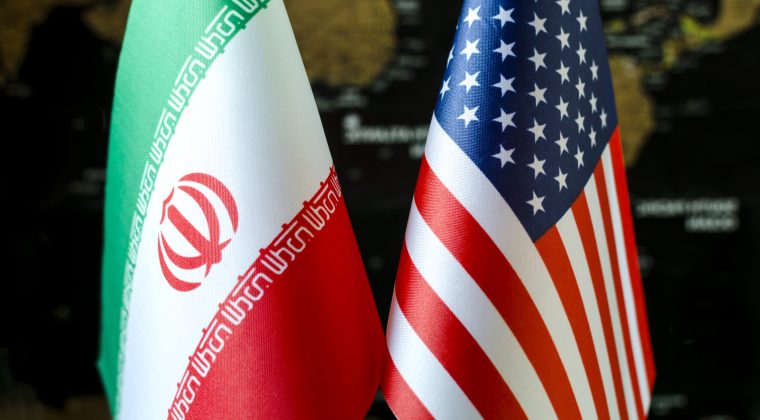
*Trump’s rejection of Iran’s latest peace proposal has sharply reduced hopes for a near-term ceasefire, keeping geopolitical tensions elevated.
*Ongoing disruption risks in the Strait of Hormuz continue to support a strong geopolitical risk premium in oil prices.
*Markets increasingly believe oil could remain structurally elevated if Middle East tensions persist through the second half of 2026.
Market Summary
Crude oil fundamentals remain firmly bullish as renewed geopolitical tensions between the United States and Iran continue to dominate global market sentiment. President Donald Trump’s rejection of Iran’s latest peace proposal as “totally unacceptable” has significantly reduced hopes for a near-term ceasefire, while ongoing disputes surrounding sanctions relief and control of the Strait of Hormuz have kept one of the world’s most important energy corridors effectively paralyzed. Markets are increasingly pricing in prolonged supply disruption risks, with Brent crude holding above $103–105 per barrel and WTI trading near $97–99 after gaining sharply in recent sessions. The Strait of Hormuz handles roughly one-fifth of global oil flows, and fears of extended shipping restrictions have forced traders to rebuild a substantial geopolitical risk premium into energy markets. Reports suggesting Trump is discussing potential renewed military action with his national security team have further intensified concerns that tensions could escalate beyond diplomacy, keeping oil prices elevated despite periodic volatility.
Supply-side conditions continue to tighten as OPEC producers struggle to offset disruptions linked to Hormuz instability. Recent reports indicate OPEC output fell toward multi-decade lows in April as export flows through the Gulf region remained constrained, while Asian refiners have reportedly begun drawing down inventories amid fears of prolonged shortages. Shipping costs and insurance premiums for energy cargoes moving through the Middle East have also risen sharply, reinforcing expectations that global crude supply could remain structurally tight for months. At the same time, the market is closely monitoring whether additional U.S. sanctions targeting Iranian oil exports particularly flows into China could further reduce available supply. Analysts now increasingly describe the current environment as a “structural geopolitical premium” rather than a temporary panic-driven rally, with forecasts suggesting Brent could remain above $100 for an extended period should disruptions persist through the second half of the year.
Oil’s sharp rise is also becoming a major macroeconomic and monetary policy issue globally. Higher crude prices are feeding directly into inflation expectations through rising transportation, manufacturing, and energy costs, creating renewed pressure on central banks already struggling to manage sticky inflation. In the United States, elevated gasoline prices around $4.50 per gallon are beginning to affect consumer sentiment, while stronger oil prices have contributed to rising Treasury yields and renewed strength in the U.S. dollar. Markets are increasingly concerned that the Federal Reserve may be forced to maintain a “higher for longer” policy stance, especially after recent resilient Nonfarm Payrolls data reduced expectations for aggressive rate cuts. The upcoming U.S. CPI release is now viewed as a critical catalyst, as another hotter-than-expected inflation print could amplify fears that oil-driven inflation pressures are reaccelerating. This environment has supported safe-haven demand for the dollar while simultaneously pressuring broader risk sentiment across equities and emerging market currencies.
Despite growing concerns over inflation and geopolitical instability, demand-side dynamics remain relatively resilient for now, particularly across Asia. OPEC continues to project solid demand growth from China, India, and other non-OECD economies, even as some agencies warn that sustained high prices could eventually trigger demand destruction and slower global growth. Meanwhile, markets are also watching the upcoming U.S.–China summit in Beijing, where President Trump will meet President Xi Jinping alongside major U.S. corporate leaders including executives from Apple, Tesla, Boeing, and BlackRock. Investors hope constructive dialogue on trade, supply chains, and geopolitical cooperation could improve broader market sentiment and potentially reduce some macro uncertainty. However, expectations for a transformative breakthrough remain limited given ongoing tensions involving Taiwan, technology restrictions, and Iran’s ties with China. As a result, oil markets are likely to remain highly headline-driven in the near term, with geopolitical developments, inflation data, and central bank expectations continuing to shape price direction and volatility across global financial markets.
Technical Analysis
Crude Oil, H4
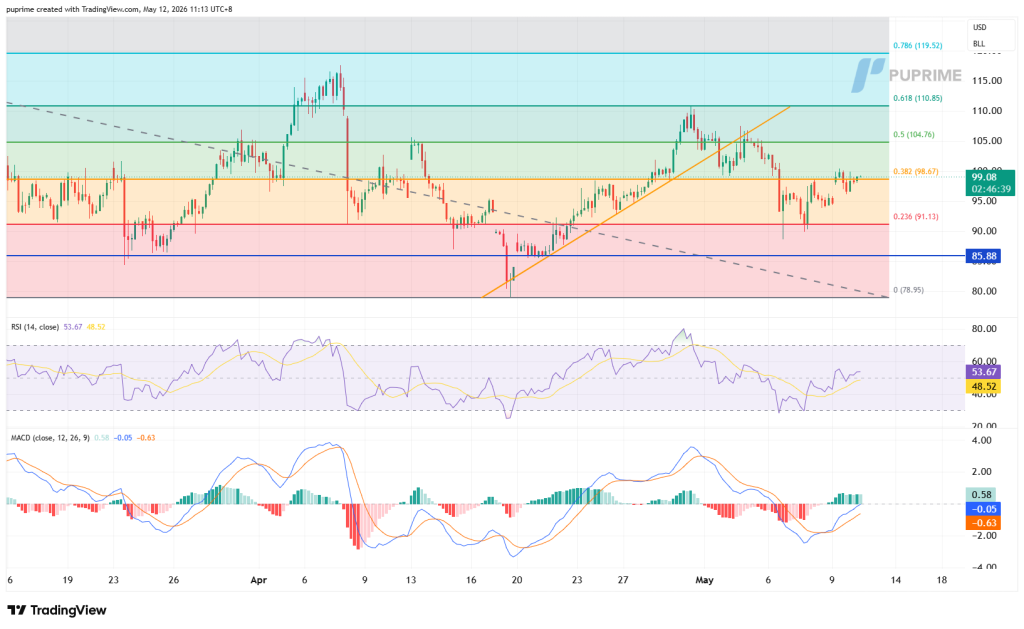
Crude oil has been attempting to stabilize after rebounding strongly from the broader support zone near 79.00–86.00, where buyers previously stepped in to defend the bearish decline. Price has since recovered above the descending trendline resistance and continues to consolidate around the 98.70 area, suggesting that downside pressure has eased compared to the earlier selloff phase.
Recent price action indicates the market is entering a more balanced consolidation structure following the sharp recovery from April lows. The previous bullish momentum slowed after failing to sustain gains above the 104.80 resistance region, but the pullback has so far remained relatively contained above the key 91.15 support zone. This suggests buyers are still attempting to maintain the broader recovery structure despite near-term hesitation.
Momentum indicators are also showing signs of gradual improvement. The Relative Strength Index (RSI) has moved back above the midpoint near 50, reflecting improving short-term momentum and a more neutral-to-positive bias. Meanwhile, the MACD has started to recover from negative territory, with bullish histogram bars gradually building again after the recent correction phase.
Overall, crude oil appears to be transitioning into a consolidation phase after its strong rebound from April lows, with price currently fluctuating around the important 98.70 region as markets assess whether recovery momentum can continue building in the near term.
Resistance Levels: 104.75, 110.85
Support Levels: 91.15, 85.90
Start trading with an edge today
Trade forex, indices, metal, and more at industry-low spreads and lightning-fast execution.
Start trading with deposits as low as $50 on our standard accounts.
Get access to 24/7 support.
Access hundreds of instruments, free educational tools, and some of the best promotions around.
Our products and services are not offered or made available to residents of your jurisdiction. The information on this Website is not directed at persons in your jurisdiction and is not intended as an offer, solicitation, or promotion of our products or services to them.
By clicking “I Understand”, you acknowledge this notice and confirm that you are accessing this Website at your own initiative. Access to this Website does not mean that our products or services are available to you.
Please be advised that our products and services are currently unavailable to residents and entities located in the Philippines.
This restriction is a result of our firm commitment to adhering to applicable legal and regulatory requirements in all jurisdictions where we operate. In line with our internal compliance protocols and evolving global standards, we continuously assess and update access to our platform to ensure full regulatory alignment.
We appreciate your understanding and cooperation.
If you believe this restriction has been applied in error, please contact our support team for further assistance.
Dear Valued Client,
As part of PU Prime’s ongoing commitment to providing a stable and reliable trading environment, please be informed of the following weekly weekend scheduled optimisation activities:
We sincerely apologise for any inconvenience this may cause as we strive to provide you with better service. PU Prime is committed to providing you with the best trading experience and this Weekly Scheduled Optimisation Notice will enable us to ensure that you trade without any unexpected interruptions.
For other upgrades that may involve longer disruptions to your trading, we will announce them ahead of time in a separate announcement.
Important Notice: Please note the Website is intended for individuals residing in jurisdictions where accessing the Website is permitted by law.
Please note that PU Prime and its affiliated entities are neither established nor operating in your home jurisdiction.
By clicking the "Acknowledge" button, you confirm that you are entering this website solely on your own initiative and not as a result of any specific marketing outreach. You wish to obtain information from this website which is provided on a reverse solicitation basis in accordance with the laws of your home jurisdiction.
Please note the Website is intended for individuals residing in jurisdictions where accessing the Website is permitted by law.
Please note that PU Prime and its affiliated entities are neither established nor operating in your home jurisdiction.
By clicking the "Acknowledge" button, you confirm that you are entering this website solely based on your initiative and not as a result of any specific marketing outreach. You wish to obtain information from this website which is provided on reverse solicitation in accordance with the laws of your home jurisdiction.
Ten en cuenta que el sitio web está destinado a personas que residen en jurisdicciones donde el acceso al sitio web está permitido por la ley.
Ten en cuenta que PU Prime y sus entidades afiliadas no están establecidas ni operan en tu jurisdicción de origen.
Al hacer clic en el botón "Aceptar", confirmas que estás ingresando a este sitio web por tu propia iniciativa y no como resultado de ningún esfuerzo de marketing específico. Deseas obtener información de este sitio web que se proporciona mediante solicitud inversa de acuerdo con las leyes de tu jurisdicción de origen.